Home/Technology/Compare technologies
Where Winback sits next to what you already own.
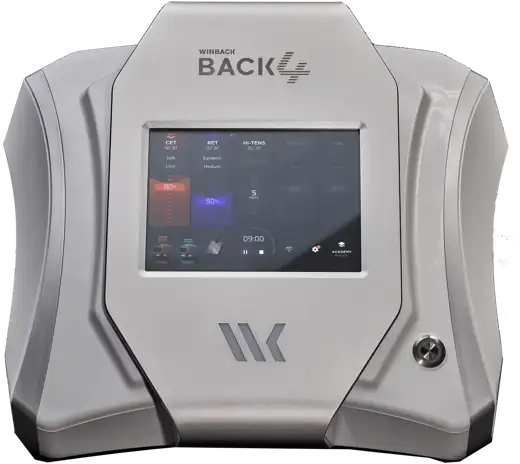
Shockwave, laser, ultrasound and standalone EMS are good at the specific jobs they were designed for. The difference with Winback is how much of the patient journey one device can stay useful for, and how many ways you can deliver it.
Side by side.
Compare on the things that decide whether a technology gets used every day or sits in a closet.
| Winback | Shockwave | Laser / photobiomodulation | Therapeutic ultrasound | Standalone EMS | |
|---|---|---|---|---|---|
| What it doesThe primary job | High-frequency energy in tissue, plus muscle stimulation and pain management in the same device | Mechanical acoustic pressure waves focused on a specific point | Light energy absorbed by tissue near the surface | Sound waves for local tissue heating | Electrical current that contracts muscle |
| Stages of the journey it coversPain, mobility, rehab, strength, performance, longevity | All six | Mainly pain and tissue | Mainly pain and tissue | Mainly tissue | Mainly rehab and strength |
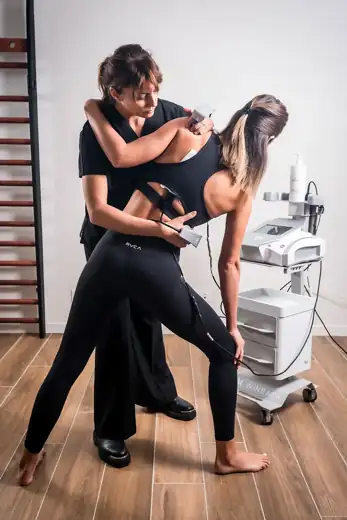
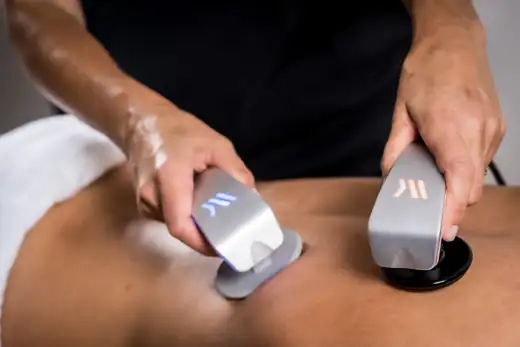
| Works through your hands | Yes, with bracelets during manual therapy | No | No | No | No |
| Hands-free delivery | Yes, adhesive electrodes and straps with guided protocols | No, applicator held on the point | Some systems, with pads or panels | No, head moved continuously | Yes, adhesive electrodes |
| Use during exercise | Yes, including muscle activation while the patient moves | No | Rarely | No | Some systems |
| Muscle activation built in | Yes, Hi-EMS | No | No | No | Yes, its primary job |
| Patient experience | Warm and comfortable, no microtrauma | Often uncomfortable during treatment | Comfortable, little sensation | Comfortable, little sensation | Muscle contractions and tingling, tolerance varies |
| Typical session | 10 to 20 minutes, or a 20 to 30 minute guided protocol | 5 to 10 minutes per area | 5 to 15 minutes per area | 5 to 10 minutes per area | 10 to 30 minutes |
| Patients per hourWith hands-free running | More than one | One | Depends on the system | One | More than one, if set up hands-free |
| Consumables | Conductive cream and electrodes | Applicator heads and gel | Minimal | Gel | Electrodes |
| Staff training | Personalized onboarding, guided protocols, ongoing education included | Moderate | Low | Low | Low to moderate |
General comparison of modality categories, not specific competitor products, and not a claim of superior clinical outcome. Capabilities vary by manufacturer and model.
One device for most of the patients you see
A device you use every day pays back differently from one you use a few times a month.
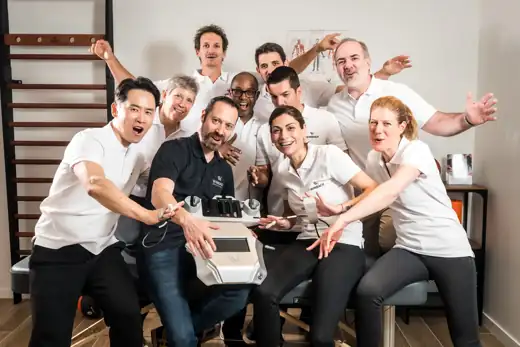
“Unlike other modalities that we use as standalone treatments, Winback has integrated into our standard treatment protocols for almost every patient we see.”
It works alongside what you have.
This isn't an argument for throwing equipment out. Clinicians pair Winback with manual therapy, exercise, dry needling and the other technologies in the room. The point is how much of the plan of care one device can stay part of.
- Combines with manual therapy in the same session
- Runs during exercise and return-to-play work
- Fits inside a standard appointment slot
- External and non-invasive, with no downtime
Try it against what you own.
Book a demo and use Winback on the cases you'd normally treat another way. That comparison is the one that counts.
Questions we hear first.
What is TECAR therapy?
TECAR stands for Transfer of Energy Capacitive and Resistive. A high-frequency current passes through the body, so the energy works inside the tissue and patients feel gentle warmth. Every Winback device also includes Hi-EMS to activate muscle and Hi-TENS to manage pain.
Is it hard to learn?
This is the question we hear most. Every device includes personalized onboarding, and the guided protocols on board mean a newer clinician can deliver a structured session on day one while they build hands-on technique. Live webinars and courses continue for as long as you own it.
How is it different from laser, ultrasound or shockwave?
Those technologies do a specific job well. Winback is built to stay useful as the patient's goals change, and it works through your hands, hands-free or during exercise. There's a full breakdown on the technology comparison page.
How long is a session?
Most treatments run 10 to 20 minutes. Guided protocols run 20 to 30 minutes and can be delivered hands-free while you work with another patient.
What support do I get after I buy?
Personalized onboarding, ongoing access to the training team, live webinars and courses, plus activation support such as open houses and marketing materials to launch it with your patients. That's the Winback Ecosystem.
Book a demo
Tell us about your practice and the right person on our team will reach out.